
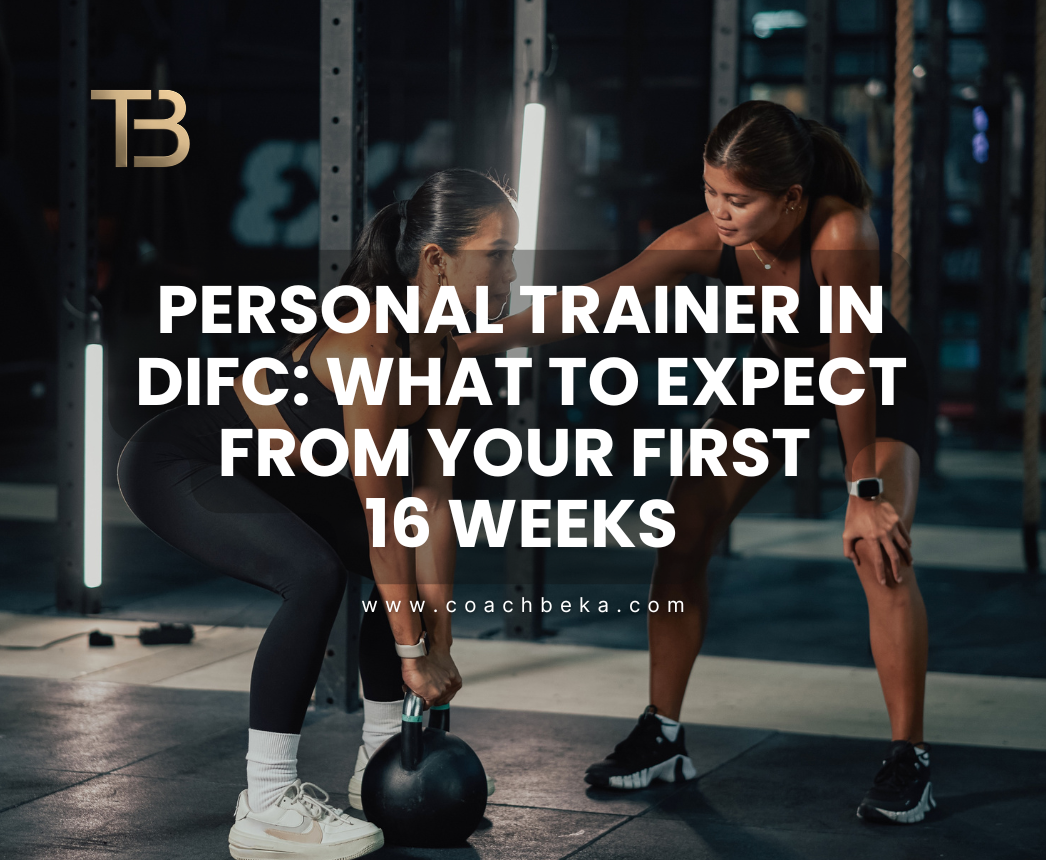
Starting with a personal trainer can be a bit daunting if you have not dabbled with such services before. What happens in your first session? How much change can you really expect in that first round of sessions? How much of it can you control? And if you are a busy professional working in and around DIFC, when would it be best to slot your training sessions in without compromising on your work?
In this blog, you will discover what typically happens with you in the first 16 weeks of working with a personal trainer, how your progress is measured, and how you can get the most out of the process.
What Happens in Your First Consultation?
First consultations are meant to focus on you and your requirements, not the other way round. A competent personal trainer will ask a series of questions to determine your requirements, such as;
- What are your training goals?
- What is your experience with training?
- Do you have any injuries?
- What is your typical daily routine like?
- How much sleep do you get?
- How is your stress levels?
- What is your diet like?
They will also be asking you what they need to know. You should leave the session understanding the framework and schedule of your training, how many sessions they expect you to have in a week, the progress review frequency, and other related aspects.
Why Does a Movement Assessment Matter?
A movement assessment determines how you do certain movements before embarking on regular training. By observing how you squat, hinge, push, pull, and balance under their supervision, a trainer gains a clear idea of your mobility, strengths, weaknesses, compensations, and other issues that would affect your training. This way, your programme will have a scientific foundation to guide the process rather than random guesswork.
What Does a 16-Week Programme Usually Look Like?
Depending on your requirements, a personal trainer’s 16-week programme is usually segmented into 4 stages. Bear in mind that the timings highlighted below are just indicative of a typical pattern.
- Weeks 1 to 4, Foundation Building: This phase entails learning all the fundamental movement patterns and finding your comfort in the process. Load management is key, and the focus is primarily on mastering form and technique.
- Weeks 5 to 8, Progressive Overloading: You start to increase the weights/resistance, repetitions, or the level of difficulty in the movements as your body adapts to the training.
- Weeks 9 to 12, Building: Having mastered the basics, it is now time to ramp up the intensity, and your progress should begin to show in terms of strength, measurements, and overall fitness.
- Weeks 13 to 16, Consolidating & Review: You and your trainer will take stock of all the changes that have taken place and make adjustments for the next phase of your training.
How Is Progress Measured?
Progress should be tracked using multiple variables as a sole reliance on the scale can be misleading. Some of the common ways of measuring progress include;
- Strength Gains: This entails tracking how much weight or resistance you can add to the bar or how many more repetitions you can perform without sacrificing form.
- Body Measurements: This includes monitoring your body dimensions at specific points and, in some cases, body composition analysis.
- Pictures: Most trainers take reference pictures of you at the beginning of your journey to use as a comparison tool later on.
- Mobility Gains and Movement Symmetry: How well you can move or perform certain movements in a better way compared to before is also a solid indicator of your progress.
- Energy Levels, Sleep, and Consistency: Energy levels and how well you rest and recover can be telling signs of your progress as well as your adherence to the nutritional and lifestyle programme.
How Often Will You Train?
A sensible first step in a personal training journey is to have two or three coached sessions in a week. This way, you have time to implement what was learned in the first few sessions and apply it when doing your independent workouts. The frequency of sessions should be dependent on your goals and how well you can recover between sessions. More is not always better, so a sustainable rate is better than a high-intensity short-term blast.
What Is Expected of You Outside Your Sessions?
Your active hours outside your personal training sessions are just as important as the ones you spend with your trainer. A competent trainer will always expect you to;
- Stick to the nutrition programme you have agreed on
- Be active within your limits on days you do not have a session
- Get enough sleep and rest for proper recovery
- Communicate your symptoms and feelings for better management
Does Training Close to Your Workplace Make a Difference?
For busy professionals, having a training space close to your workplace can make a world of a difference. It saves time and energy and ensures there is little or no disruption to your training. And with a personal trainer, you have the option to either have morning, afternoon, or evening sessions depending on your schedule. Fewer obstacles usually mean more consistency, which is the bedrock of successful training.
What If Progress Slows Down?
It is quite normal for progress to slow down at some point, and it is never a reason to give up or go back. Some of the reasons why progress might slow down or stall include work stress, travel, poor sleep, or even being in a stalemate. In such instances, the best thing to do is to look at the bigger picture and make some modifications to your current lifestyle and fitness regimen rather than just pushing harder.
In Conclusion
The first 16 weeks of personal training is all about laying a solid foundation and being progressive in your training. As long as you have someone that works with you to find a programme that is sustainable for you, you are likely to find success in your fitness journey.
If you work in DIFC and are looking for a reliable and competent personal trainer, look for someone that offers a consultation and movement assessment, tracks your progress using multiple indicators, and has a framework that is flexible enough to make modifications as you progress.
Copyright 2026 coachbeka.com All rights reserved.