
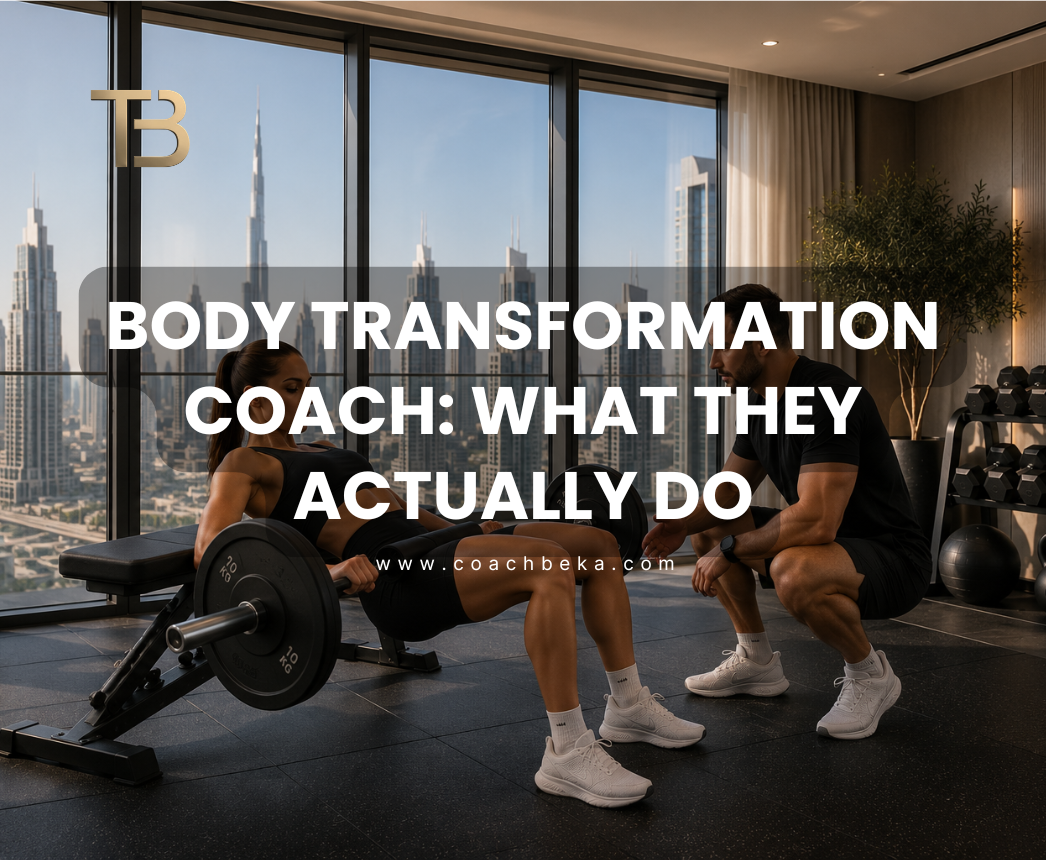
Search “body transformation” and you get thousands of 12-week programs, meal plans, and PDFs promising dramatic results. Most of them do not work, and not because the exercises are wrong. A program on its own cannot account for your body, your schedule, your old injuries, or how you actually respond to training over time. That gap is exactly what a body transformation coach exists to fill.
This guide explains what a body transformation coach really does, why generic programs so often stall or reverse, and what to look for if you are considering hiring one.
The Short Answer
A body transformation coach manages the entire process of changing your body composition, training, nutrition, recovery, and accountability, adjusting each element based on real data from your progress. A generic program is fixed from day one. A coach’s program evolves as your body changes, which is the main reason coached transformations tend to last while self-guided ones often do not.
Why Most Self-Guided Programs Fail
Before looking at what a coach does, it helps to understand why unsupervised programs so often break down.
- They are not personalized: A 12-week PDF cannot account for your joint mobility, injury history, stress levels, or how your metabolism responds to a calorie deficit. It treats everyone the same, which means it works well for some people and poorly for most.
- They do not adjust: Your body adapts to training and dieting over time. A fixed program has no mechanism to respond when progress slows, which is exactly when most people quit.
- They lack accountability: Motivation fades. Life gets busy. Without someone checking in, tracking progress, and helping you problem-solve, small lapses turn into abandoned programs.
- They ignore recovery and lifestyle: Sleep, stress, and travel affect results as much as training does. Generic programs rarely address these factors, leaving people to figure it out alone.
A body transformation coach exists specifically to close these gaps.
What a Body Transformation Coach Actually Does
1. Starts With a Real Assessment
Before writing a single workout, a proper coach evaluates your posture, movement patterns, mobility, injury history, current fitness level, and lifestyle constraints. This is where corrective exercise and biomechanics training matter. Two clients with the same goal might need entirely different starting points based on how their bodies actually move.
2. Builds a Program Around Your Body, Not a Template
Using the assessment data, a coach designs training that fits your joints, your schedule, and your goals. This might mean modifying a squat pattern for someone with knee pain, or structuring sessions around a client who travels three weeks a month. The program is engineered for the individual, not copied from a generic transformation guide.
3. Manages Nutrition Based on Your Actual Needs
A coach with proper nutrition credentials calculates your calorie and macronutrient targets based on your body, activity level, and goals, then adjusts them as your metabolism responds. This is different from a fixed meal plan, which cannot account for plateaus, travel, or how your body changes over the course of the program.
4. Tracks Progress With Real Data
Rather than relying on the scale alone, a coach monitors strength benchmarks, body composition, recovery quality, and mobility over time. This data tells them exactly what is working and what needs to change, long before a client would notice a plateau on their own.
5. Adjusts the Program as You Change
This is the core difference between coaching and a fixed program. If fat loss stalls in week 6, a coach knows whether to adjust calories, training volume, recovery, or all three. A static plan has no way to respond to this kind of feedback, which is why so many self-guided transformations stop working after the first few weeks.
6. Provides Accountability Through the Hard Weeks
Every transformation includes weeks where motivation drops. A coach checks in, reviews adherence, and helps clients problem-solve around travel, stress, or plateaus, rather than letting small lapses turn into abandoned programs. This ongoing support is often the single biggest factor separating people who finish a transformation from people who quit partway through.
7. Builds a Plan for Long-Term Maintenance
A good coach does not just get you to a goal, they help you stay there. This means gradually shifting from an intense transformation phase into a sustainable maintenance approach, so results do not reverse the moment structured coaching ends.
Real Transformation Requires More Time Than Marketing Suggests
One reason generic programs disappoint people is that they promise faster results than physiology actually allows. A realistic timeline looks like this:
- Weeks 1 to 4: Improvements in energy, strength, and consistency. Minimal visible change.
- Weeks 6 to 8: Early visible changes in body composition, particularly with proper nutrition support.
- Weeks 12 to 16: Noticeable transformation in most clients following a structured program.
- Weeks 16 to 24: Significant, often life-changing results for clients with more complex starting points, such as chronic pain, larger fat loss goals, or long histories of inconsistent training.
A coach sets these expectations early and adjusts the plan as reality unfolds, rather than promising a dramatic before-and-after in three weeks.
What This Looks Like in Practice
Consider a client in their early 50s with chronic knee pain, a demanding leadership role, and a history of failed programs. A generic 12-week plan built around generic squats and a fixed calorie target would likely aggravate the knee pain and fail to account for a packed travel schedule.
A body transformation coach instead builds joint-friendly training around the knee limitation, calculates nutrition based on the client’s actual metabolic needs and travel patterns, and adjusts the plan monthly based on real progress data. Over 16 weeks, this kind of approach can produce significant, sustainable fat loss and eliminate pain that generic programs never addressed, because the plan was built around the person, not a template.
Frequently Asked Questions
- What is the difference between a body transformation coach and a personal trainer? A personal trainer often focuses primarily on supervising workouts. A body transformation coach typically manages the full process, training, nutrition, recovery, and accountability, and adjusts the plan continuously based on your progress.
- Why do generic 12-week programs usually fail? They are not personalized to your body or lifestyle, they do not adjust when progress stalls, and they lack the accountability that keeps most people consistent through a multi-month process.
- How long does a real body transformation take? Most people see early visible changes around weeks 6 to 8, with significant transformation typically appearing between weeks 12 and 24, depending on starting point and goals.
- Is a body transformation coach worth it if I already know how to train? Even experienced trainees benefit from coaching when they hit plateaus, deal with injuries, or need their program adjusted based on real progress data rather than guesswork. Coaching becomes especially valuable when self-directed efforts have stalled.
- Does a body transformation coach only focus on workouts? No. A proper coach manages nutrition, tracks recovery and progress data, and provides accountability alongside training, since all of these factors influence whether a transformation actually holds long term.
Lasting Results Need More Than a Programme
Most transformation programs fail for the same reason: they are fixed, generic, and disconnected from how your specific body responds over time. A body transformation coach solves this by assessing you properly, building a program around your actual needs, and adjusting it continuously based on real data and accountability. That process, not the workout plan itself, is what turns short-term effort into lasting change.
If you’re considering working with a body transformation coach, take the time to understand how they assess clients, build programmes, and adapt them over time. Coach Beka offers personalised coaching designed around your goals, lifestyle, and long-term progress.
Copyright 2026 coachbeka.com All rights reserved.